• Welcome to your new Gnomio site

    Now, you are in control!

    Moodle is an open-source Learning Management System (LMS) that provides educators with the tools and features to create and manage online courses. It allows educators to organize course materials, create quizzes and assignments, host discussion forums, and track student progress. Moodle is highly flexible and can be customized to meet the specific needs of different institutions and learning environments.

    Moodle supports both synchronous and asynchronous learning environments, enabling educators to host live webinars, video conferences, and chat sessions, as well as providing a variety of tools that support self-paced learning, including videos, interactive quizzes, and discussion forums. The platform also integrates with other tools and systems, such as Google Apps and plagiarism detection software, to provide a seamless learning experience.

    Moodle is widely used in educational institutions, including universities, K-12 schools, and corporate training programs. It is well-suited to online and blended learning environments and distance education programs. Additionally, Moodle's accessibility features make it a popular choice for learners with disabilities, ensuring that courses are inclusive and accessible to all learners.

    The Moodle community is an active group of users, developers, and educators who contribute to the platform's development and improvement. The community provides support, resources, and documentation for users, as well as a forum for sharing ideas and best practices. Moodle releases regular updates and improvements, ensuring that the platform remains up-to-date with the latest technologies and best practices.

    Links of interest:

    (You can edit or remove this text)

Available courses

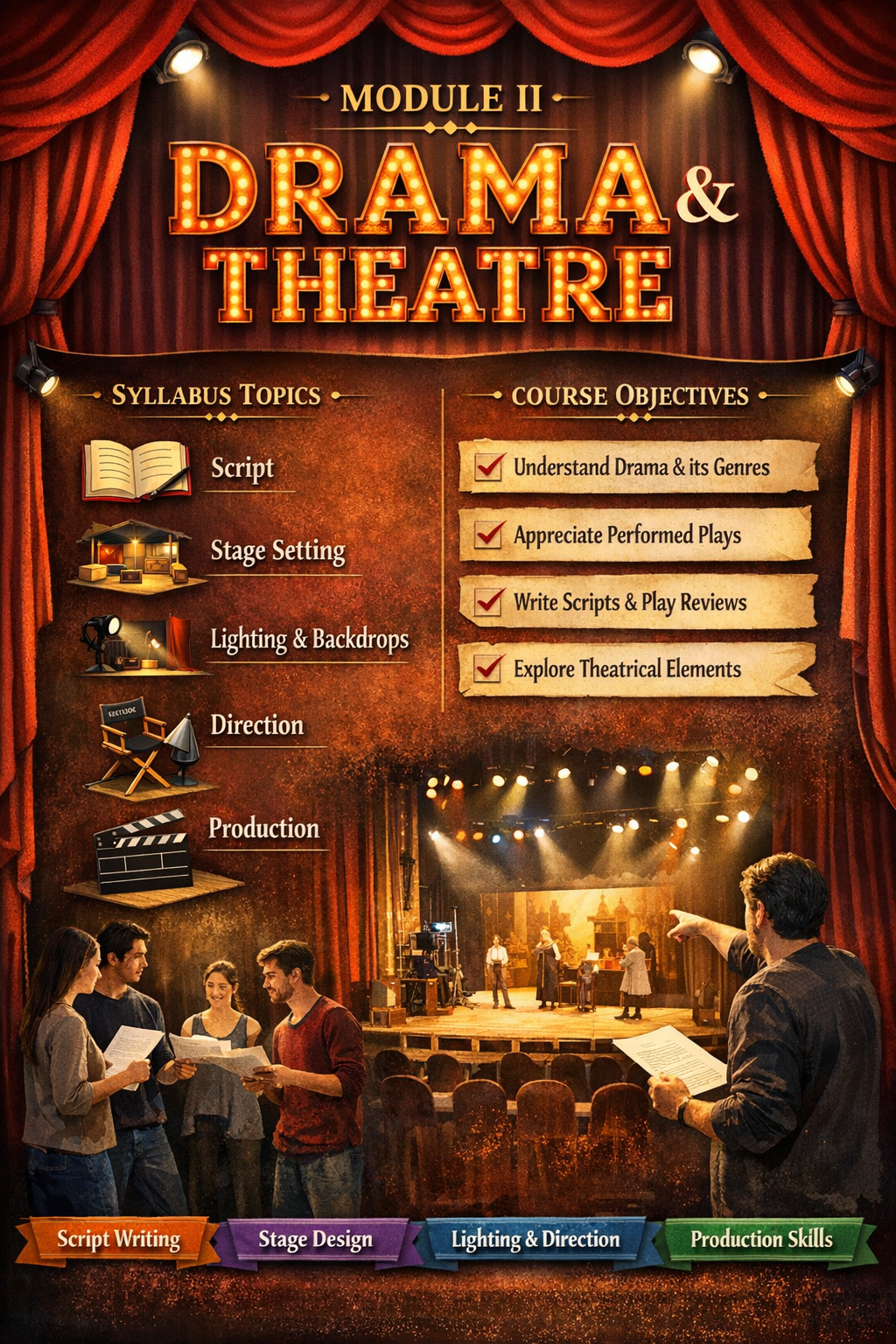
Module II – Drama & Theatre

Module II introduces students to the theoretical and practical foundations of theatre, emphasizing drama as a performed art form rather than merely a literary text. Through focused study of the key components of theatre—script, stage setting, lighting and backdrops, direction, and production—students gain an integrated understanding of how a play moves from page to stage.

The module familiarizes learners with the structural and aesthetic elements of dramatic composition, enabling them to analyze scripts critically while also appreciating the collaborative nature of theatrical performance. Students explore how stage design, lighting, and visual backdrops contribute to mood, meaning, and audience engagement, and how the director’s vision shapes interpretation and execution. Attention is also given to production processes, highlighting the coordination of artistic, technical, and managerial roles in theatre.

By combining critical analysis with practical exposure, the course develops students’ ability to appreciate live performances, write original scripts, review plays with informed judgment, and understand the mechanics involved in staging a production. Overall, Module II equips students with both conceptual clarity and applied skills, enabling them to identify, discuss, and evaluate the theoretical and practical dimensions of drama and theatre.